

Before booking a cenote trash the dress
What Couples Usually Worry About Before Booking a Cenote Trash the Dress
Before booking a cenote Trash the Dress, many couples have very understandable doubts. Will the dress be ruined? Will we actually be able to do it? And what happens if one of us feels much less comfortable in water than the other?
This page brings those questions into the open. Below, you’ll find clear answers, the full podcast conversation, and the complete transcript for anyone who prefers reading instead of listening.
In short
- the dress is not ruined
- the experience is much easier than most people imagine
- different comfort levels in a couple are normal and manageable
- the whole process is guided step by step
Will a cenote Trash the Dress really ruin the wedding dress?
Many brides ask this first, and the question makes complete sense. A wedding dress is never just fabric. It carries memory, symbolism, and emotion, so hesitation is natural.
In real life, a cenote Trash the Dress is usually much gentler than the phrase itself suggests. In a cenote, the dress goes into fresh water, not salt water and not chlorine, which already makes a meaningful difference.
After the session, the dress simply needs time to drain and dry properly. For long-term care, professional cleaning is always the right step, just as it would be after the wedding itself.
And if using the real wedding dress does not feel right, there is no need to force that decision. We also provide dresses free of charge, so the bride can still enjoy the feeling and beauty of the experience without using the gown that matters most to her.
The real question is not whether you must be brave enough to risk the dress, but whether you can choose the version of the experience that feels right for you.
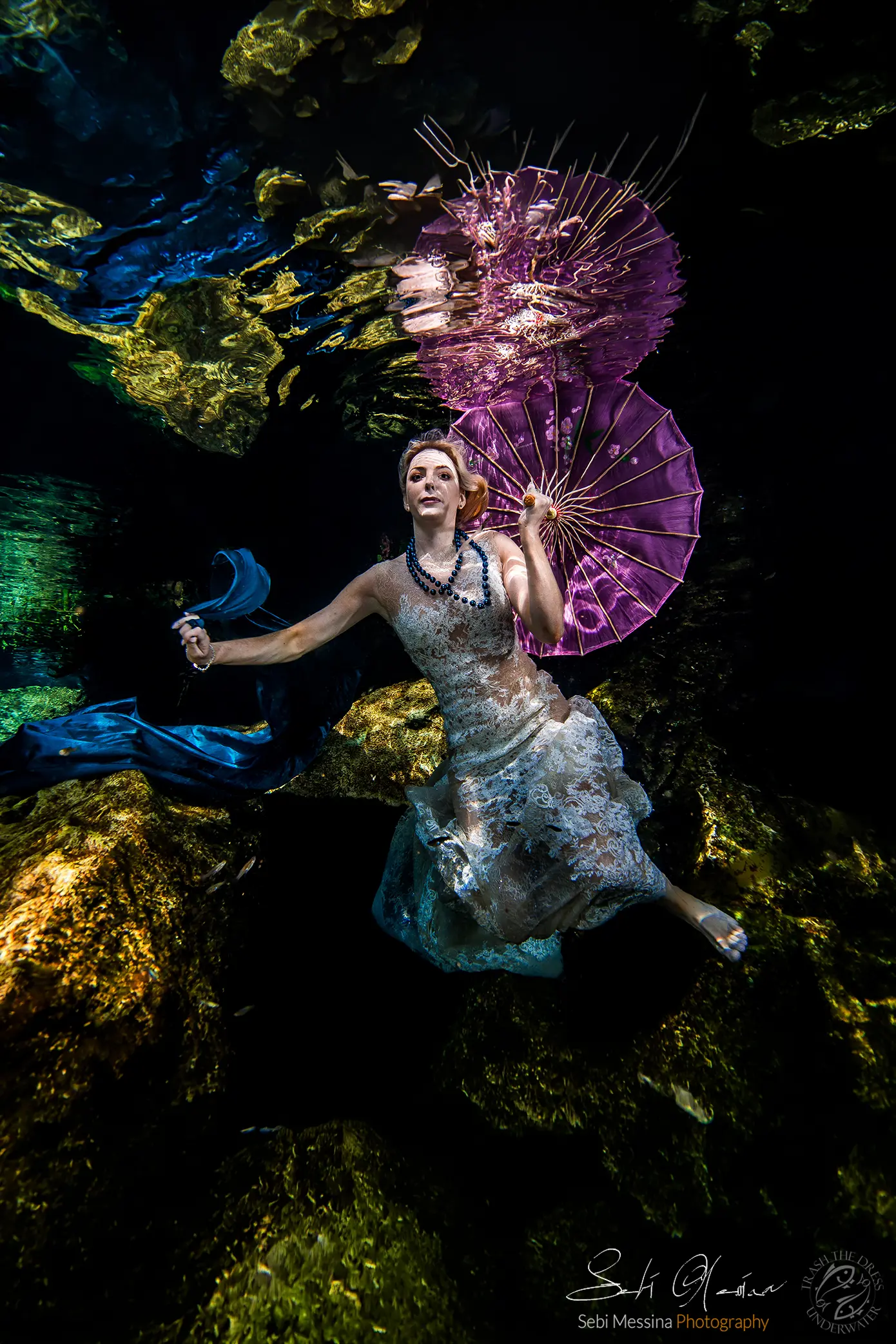
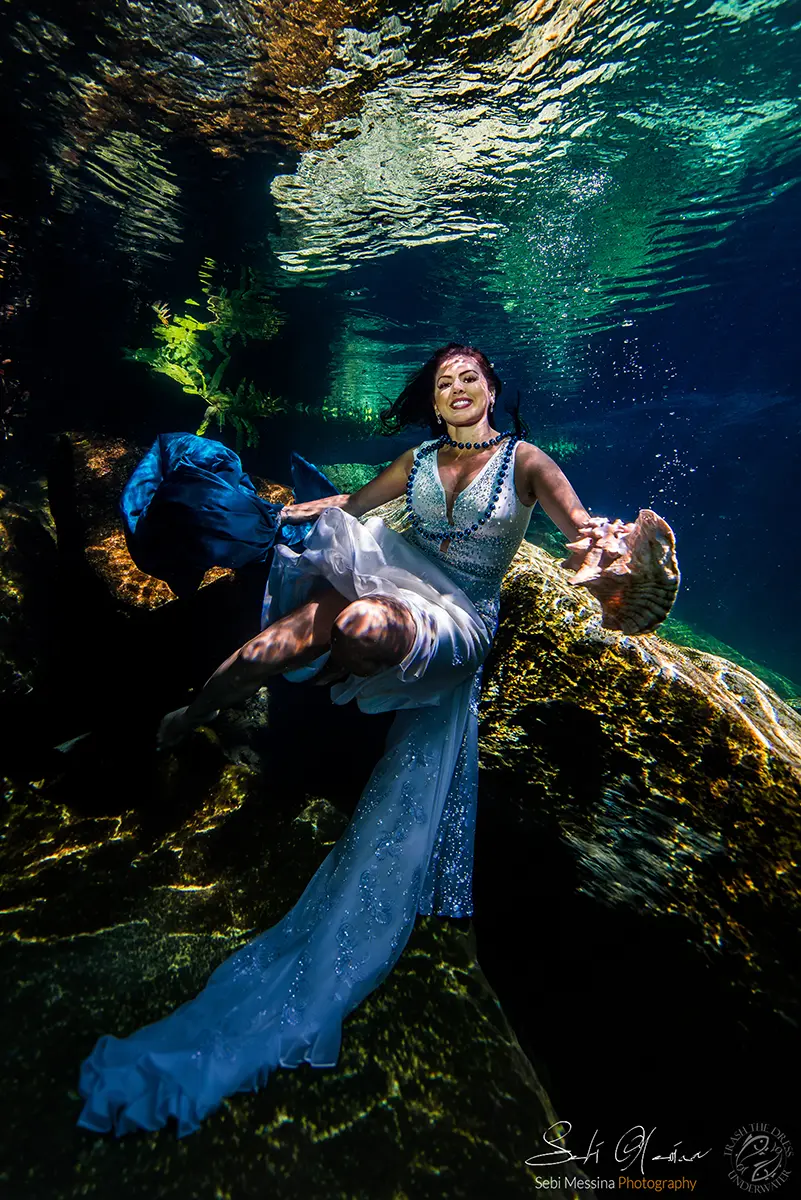
What if we think we’re not capable of doing it?
For many couples, this is the deeper fear. Not the dress, but the quiet doubt of whether they will actually be able to do it, stay calm underwater, and still feel graceful rather than awkward.
That is why the experience never begins as a performance. Nobody is expected to arrive already confident, experienced, or technically prepared. People are not being examined. They are being guided.
Everything begins with a calm briefing on land. We explain the essentials clearly and lightly, including breathing, facial expression, movement, and the easiest way to approach the first descents.
One of the biggest turning points is simply understanding that each descent is very short, usually around ten to fifteen seconds. Once people hear that, the entire experience starts feeling much more realistic and much less intimidating.
And when the couple first enters the water, the actual photoshoot has not really started yet. That first phase is still a calm rehearsal, a gradual extension of the preparation on land, where confidence is built step by step rather than demanded all at once.
Most people discover that a cenote Trash the Dress is not harder than they imagined — it is usually much easier.
What if one partner feels much less comfortable in water than the other?
This is extremely common. In many couples, one person feels more relaxed in water while the other needs more time. That difference is not unusual, and it is not a problem in itself.
A couple does not need to begin from the same comfort level in order to create beautiful images. What matters is that the session is guided in a way that respects both people honestly.
In practice, the rhythm is always built around the person who needs more time. That does not take the experience away from the stronger partner. It simply means the session unfolds intelligently, without pressure and without making anyone feel like “the difficult one.”
Very often, once the less confident partner starts feeling calmer, the whole couple dynamic changes. The more comfortable partner relaxes too, and the experience becomes shared in a much more natural and enjoyable way.
Couple images do not depend on perfect performance. They depend on connection, ease, trust, and the atmosphere created around the two people. And that is often where the real beauty comes from.
Different comfort levels are normal. The important thing is not starting from the same point, but being guided at the right pace.


and
Learn more about our packages
If you’d like to explore the full Underwater Trash the Dress experience in more depth, visit our main page for more information, inspiration, and images.
Explore our main Underwater Trash the Dress page
If you’d like to see more real examples, explore our Underwater Trash the Dress gallery in Mexico and get a better feel for the visual style of the experience.
Browse more real Trash the Dress images in Mexico
Listen to the full conversation
This podcast episode explores the three biggest worries couples usually have before booking a cenote Trash the Dress, and the reality behind them.
Full podcast transcript
Prefer reading instead of listening? Here is the complete conversation.
Full podcast transcript
Interviewer:
Hello everyone, and welcome.
Today we’re talking about something that fascinates many couples, but also raises very understandable doubts.
The idea of doing a cenote Trash the Dress in Mexico can feel exciting, beautiful, and unforgettable… but also a little intimidating at first.
And to explore that honestly, I’m joined today by Sebi Messina.
Sebi is an Italian underwater photographer based in Mexico, and since 2013 he has specialized in cenote underwater photography in the Riviera Maya.
His work includes Trash the Dress, Underwater Modeling, and Underwater Maternity sessions, always with a calm, guided, and very personal approach.
Sebi, welcome. It’s a pleasure to have you here.
Sebi:
Thank you. It’s a pleasure to be here.
Interviewer:
Many couples are drawn to the idea of a cenote Trash the Dress, but they also arrive with very real questions.
Will the dress be ruined?
Will we actually be capable of doing it?
And what happens if one partner feels much less comfortable in water than the other?
So that is really the question we want to explore today.
What do couples usually worry about before booking a cenote Trash the Dress… and what is the reality?
Sebi:
Well, most of those worries are very understandable.
But in real life, the experience is usually much gentler, much easier, and much more manageable than people imagine at first.
Interviewer:
Let’s start with the first and most obvious concern.
Will a cenote Trash the Dress really ruin the wedding dress?
Sebi:
Very often, that is the first concern.
And honestly, I completely understand it.
A wedding dress is never just fabric.
It carries memory, emotion, and symbolism.
So when a bride hesitates, I never treat that fear lightly.
Interviewer:
So the hesitation is not superficial at all.
Sebi:
Not at all.
It is emotional before it is practical.
And that is exactly why it deserves respect.
Interviewer:
And probably even the phrase “Trash the Dress” creates a stronger image than the reality.
Sebi:
That’s true.
The name sounds harsher than the experience usually is.
It suggests something wild, destructive, maybe even reckless.
But in practice, especially in a cenote, it is usually much gentler than people think.
Interviewer:
So when a bride asks you that question directly, what do you normally tell her?
Sebi:
I usually tell her something very simple.
The dress is washed, not sacrificed.
By the time the Trash the Dress happens, that gown has already lived its first life on the wedding day.
It has already touched the ground, maybe collected dust, maybe a little sand, maybe a few small marks.
So what people imagine is often much more dramatic than what really happens.
Interviewer:
And in a cenote, the type of water makes a big difference.
Sebi:
It does, a very important one.
In a cenote, the dress goes into fresh water.
Not salt water, and not chlorine.
Salt and chlorine are harder on fabric.
Fresh water is much gentler.
Interviewer:
So in that sense, the environment is already less aggressive than many people assume.
Sebi:
Exactly.
After the session, the dress simply needs time to drain and dry.
We usually recommend hanging it in the room.
Air conditioning helps, because the air is dry and the fabric dries faster.
And then, for proper long-term care, professional cleaning is always the right step.
Interviewer:
But that would be wise anyway, even without an underwater session.
Sebi:
That’s right.
A wedding dress should normally be cleaned professionally in any case.
So the real picture is not destruction.
The real picture is much calmer, much more reasonable, and much more manageable than the imagination often suggests.
Interviewer:
And what if a bride still feels that using her actual wedding dress is simply too emotional?
Sebi:
Then that feeling should absolutely be respected.
There should never be pressure.
If the dress feels too sentimental, too important, or simply too irreplaceable, then it may be better not to use it.
And that is exactly why we also offer dresses free of charge.
Interviewer:
So there is a real alternative.
Sebi:
There is.
We send a file in advance so the bride can see the dresses clearly, both outside the water and underwater.
That way she can choose calmly.
If she wants to use her own dress, wonderful.
If she prefers to use one of ours, that is also perfectly fine.
Interviewer:
So the message is not, “Be brave and take the risk.”
Sebi:
No.
The message is, let’s find the version that feels right for you.
Because once that first fear softens, everything else becomes easier too.
Interviewer:
And once that fear begins to soften, another one often appears.
Maybe an even more personal one.
What if we’re simply not capable of doing this?
Sebi:
In many cases, that is the deeper fear.
People do not always say it openly, but you can feel it.
They may be wondering, “Will I really be able to do this? Will I panic? Will I look awkward? Will I disappoint myself?”
Interviewer:
So this is not really about vanity.
It is more about self-doubt.
Sebi:
It is.
It becomes personal.
It is not about the dress anymore.
It is about whether the person feels capable of entering a new situation and still feeling calm, graceful, and in control.
Interviewer:
And where do you begin when someone arrives with that kind of doubt?
Sebi:
I begin by removing the pressure.
They do not need to be underwater models.
They do not need previous experience.
They do not need to arrive already confident.
Almost nobody does.
They are not being tested.
They are being guided.
Interviewer:
That alone probably changes the atmosphere immediately.
Sebi:
Very much so.
Because they realize this is not something extreme.
They are not about to do something like bungee jumping or skydiving.
They are about to do something much simpler, much calmer, and much more beautiful than they had imagined.
Interviewer:
And I suppose a lot depends on what happens before anyone even enters the water.
Sebi:
Very much so.
The experience starts on land, with the briefing.
And I do not mean a cold or technical lecture.
Of course we explain the essentials clearly, but the atmosphere is relaxed, human, and reassuring.
Interviewer:
What do you usually cover in that phase?
Sebi:
We go through the small things that make everything easier.
The eyes.
The facial expression.
The body position.
How to move with the dress.
How to approach the descent.
How to stay calm.
Step by step.
Interviewer:
And what is usually the biggest relief for people once you explain the real mechanics of it?
Sebi:
Breathing.
Very often, that is the turning point.
People imagine they may have to stay underwater much longer than they actually do.
But then we explain something simple.
Each descent lasts only around ten to fifteen seconds.
Interviewer:
Which immediately makes it sound much more manageable.
Sebi:
It does.
Because almost anyone can hold their breath for ten or fifteen seconds.
The moment that becomes clear, the whole idea stops feeling intimidating and starts feeling realistic.
Interviewer:
And once they enter the water, the actual photoshoot does not begin immediately.
Sebi:
No, never.
That first in-water phase is still part of the preparation.
It is really an extension of the briefing on land.
More like a calm rehearsal than a real photoshoot.
We always start gently.
And we usually start with the bride, because she also has the dress to manage and may naturally need a few extra moments.
Interviewer:
So confidence is built, not demanded.
Sebi:
Exactly.
We break it into very small parts.
The eyes.
The expression.
Counting.
The legs.
The overall body position.
Then, little by little, those pieces come together.
There is no rush.
Interviewer:
That sounds very different from the way people often imagine modern photoshoots, as something fast and mechanical.
Sebi:
That happens quite often, actually.
Some people assume everything today must happen quickly, almost like a production line.
But that is not how we work.
A photoshoot with us is never fast-food photography.
Interviewer:
What is it instead?
Sebi:
Something much closer to an artisanal experience.
Something carefully guided and carefully built.
We only move forward when the person feels ready enough to move forward.
Interviewer:
And then, at some point, the doubt begins to change.
Sebi:
It does.
Little by little, they stop thinking, “Can I do this?”
And they begin to feel, “Actually, yes. I can.”
And once that happens, they start enjoying it.
Interviewer:
So the reward is not only the photograph.
Sebi:
No.
The reward is also the feeling of discovering that they were more capable than they thought.
And because they are living it together as a couple, it becomes even more meaningful.
It is not only a personal achievement.
It is a shared first time.
Interviewer:
And that brings us to another very real situation with couples.
Not necessarily that both people are afraid, but that one feels much more comfortable in water than the other.
Can a cenote Trash the Dress still work when the couple does not start from the same level of confidence?
Sebi:
Absolutely.
In fact, that is very normal.
In many couples, one person is more relaxed in water and the other is more hesitant.
That never surprises us.
Interviewer:
So the difference itself is not the problem.
Sebi:
Not at all.
It is simply something to understand and work with.
We never expect both people to react in exactly the same way.
That would not be realistic.
What matters is recognizing the difference and guiding the session accordingly.
Interviewer:
I imagine the real risk would be making the less confident partner feel like the one slowing everything down.
Sebi:
Exactly.
And that is something we are very careful about.
The person who feels less comfortable should never feel judged, rushed, or treated like a problem.
The moment someone feels that kind of pressure, everything becomes harder.
Interviewer:
So from the beginning, the atmosphere has to say the opposite.
Sebi:
Yes.
Calm.
Patience.
And the feeling that there is space for both people exactly as they are.
Interviewer:
So how do you actually handle that difference once the session begins?
Sebi:
We pace the session around the person who needs more time.
Always.
That does not reduce the experience for the stronger partner.
It simply means the rhythm is built intelligently.
Interviewer:
So the less confident partner sets the tempo.
Sebi:
That’s right.
Because that is the only tempo that really makes sense.
If one person needs more reassurance, more repetition, or a longer rehearsal phase, then that is what we do.
Interviewer:
And does that change the first in-water phase?
Sebi:
Very often, yes.
That first phase remains a calm rehearsal, not the real photoshoot yet.
We keep everything simple.
Very short descents.
Clear guidance.
Small goals.
Nothing dramatic.
Interviewer:
So you are not trying to force symmetry inside the couple.
Sebi:
Not at all.
We are not trying to make both people feel the same thing at the same speed.
We are simply helping each of them arrive at a point where they can enjoy the experience together.
Interviewer:
And once the less confident partner starts feeling safer, the whole dynamic probably changes.
Sebi:
Completely.
Because then the more comfortable partner relaxes too.
They stop worrying about the other person.
And the session begins to feel shared in a much more natural way.
Interviewer:
Some couples might assume that if one partner is less comfortable, the couple images will suffer.
Sebi:
Not necessarily at all.
Very often, the opposite happens.
Once the pressure is removed, the connection becomes more authentic.
The photos do not need two people performing perfectly.
They need two people feeling present, connected, and at ease.
Interviewer:
So the beauty of the images does not come from forcing confidence.
Sebi:
Exactly.
It comes from creating the right conditions for confidence to appear naturally.
And when one partner needs a little more care, that does not weaken the experience.
In many cases, it makes it more human, more tender, and more memorable.
Interviewer:
So if we step back and look at the three worries we talked about today, the pattern becomes very clear.
People fear that the dress will be ruined.
They fear they may not be capable.
And sometimes they fear that one partner may hold the other back.
But the reality is usually much calmer than the imagination.
Sebi:
I would say that is the key point.
Most of these fears are understandable, but they are also usually much larger in the imagination than in the real experience.
Interviewer:
So if a couple is listening right now and wondering whether a cenote Trash the Dress may simply be too risky or too difficult for them, what would you say?
Sebi:
I would say this.
A cenote Trash the Dress is usually far less risky and far less difficult than people imagine.
With the right pace, the right guidance, and the right atmosphere, it stops feeling like a stressful challenge.
And it becomes something beautiful that the couple lives together.
Interviewer:
So perhaps the most truthful summary is not that people need to be fearless.
It is that they need to be guided well.
Sebi:
Absolutely.
That is the real difference.
Interviewer:
Beautiful.
Thank you, Sebi.
Sebi:
Thank you.
and
Learn more about our packages
Awards

About us

Follow us on Instagram

Follow us on Facebook

Beachy Bride Certified